Bulk Delete Google Workspace Users from Sheets

SheetOps Google Sheets Add-on
This guide is for the official SheetOps add-on. Install it to manage Google Workspace at spreadsheet speed.
Permanently deleting Google Workspace accounts is a critical phase of any IT offboarding checklist. SheetOps allows you to safely delete users in bulk, saving up to 95% of administrative time compared to manual console clicks, while providing a safety net to fetch and restore recently deleted accounts directly from Google Sheets.
[!NOTE] Quick Answer: To bulk delete Google Workspace users with SheetOps: export your users to a sheet, change their Status to Deleted, select the Apply Changes checkboxes, and execute the update. This immediately revokes login access and deletes their Workspace data after a 20-day restorable window.
Understanding User Deletion Mechanics
Changing a user's status to Deleted in the spreadsheet instructs SheetOps to make a delete API call to the Google Directory API's users.delete (historically Users.remove()) method. Additionally, SheetOps can query Google Workspace's "recently deleted" bin and perform restorations using the users.undelete endpoint within a 20-day window.
Google Admin Console vs. GAM vs. SheetOps for User Deletion
While you can delete users manually in the Google Admin Console or write terminal scripts using GAM, SheetOps provides a safer, faster way to manage deletions at scale:
| Criteria | Admin Console | GAM CLI | SheetOps |
|---|---|---|---|
| Bulk Operations | Manual deletion in console or rigid CSV uploads | Scripted command-line commands | Familiar copy-paste and fill-handle drag in spreadsheets |
| Safety Net | None (deletions are immediately executed) | None (deletions are immediately executed) | Live validation and visual staging (highlighted in yellow) |
| Restoration | Manual console search (user-by-user) | Requires running another CLI command | Fetch deleted users, toggle status to 'Active', and apply |
| Change Tracking | Admin audit logs in console | Command line output logs | Real-time status updates directly in the sheet's Change Log column |
How to Bulk Delete Google Workspace Users
1. Prepare Your Spreadsheet Template
To target and update users, you have two options to bring them into the sheet:
- Fetch with Filters: Go to Extensions → SheetOps → Users, select Fetch with Filters, and choose your target criteria (such as a specific organizational unit) to bring existing users to the sheet. For a detailed guide on how to filter workspace users, refer to the filtering guide. Once imported, you can delete accounts as needed.
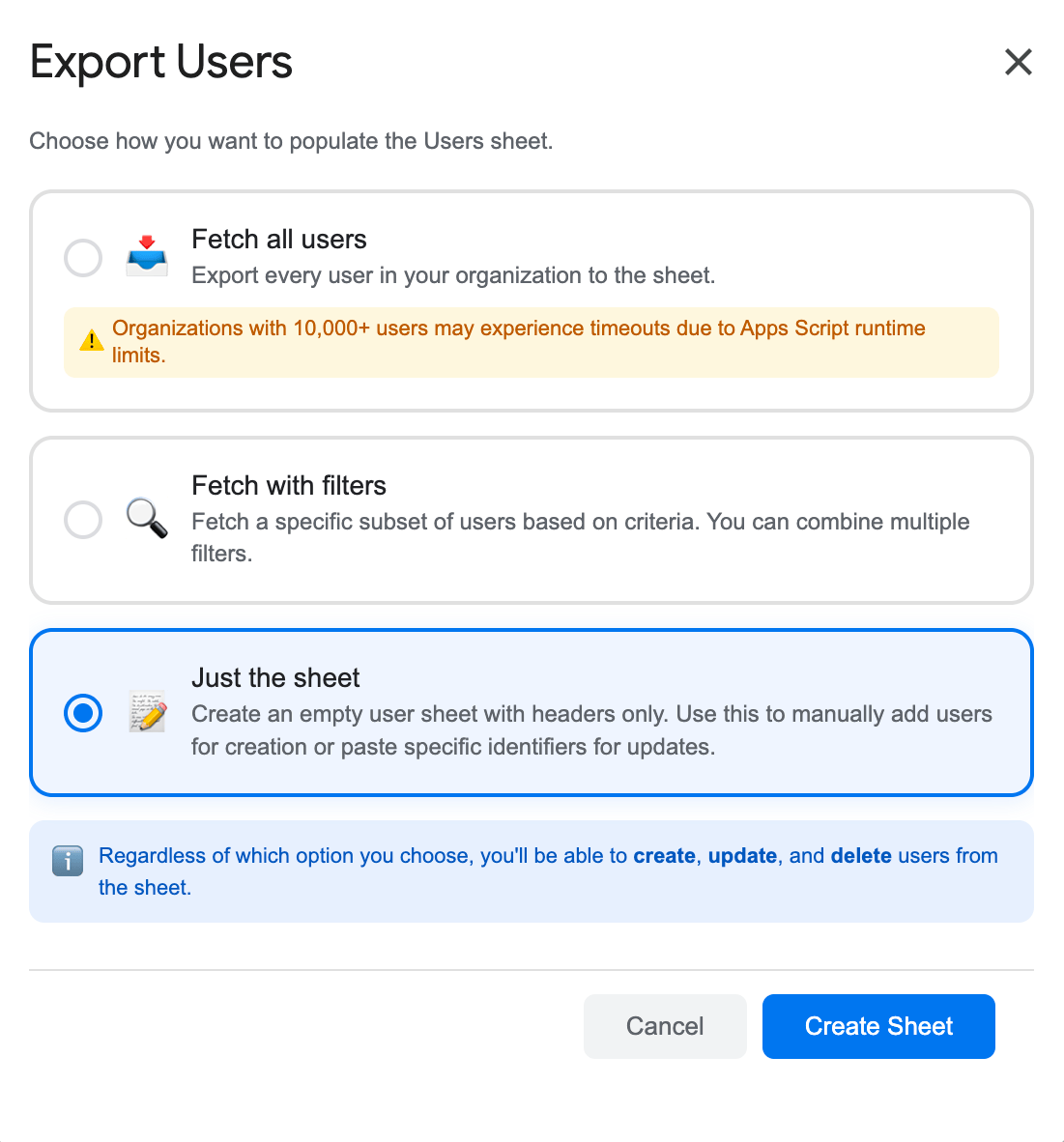
- Just the Sheet: Go to Extensions → SheetOps → Users, select Just the Sheet, and click Create Sheet to generate a clean template. You can then simply input the user email and change their status.
2. Modify Status to Deleted
In the user sheet, locate the Status column (the third-to-last column):
- For the first user you want to delete, select Deleted from the dropdown menu.
- Bulk Action Tip: Instead of manually selecting the dropdown for every single row, you can select the "Deleted" value on the first row, click and hold the fill handle (the small square in the bottom-right corner of the cell), and drag it down over the other user rows. This instantly copies the Deleted status across all selected rows.
- All cells with pending data or updates will highlight yellow.
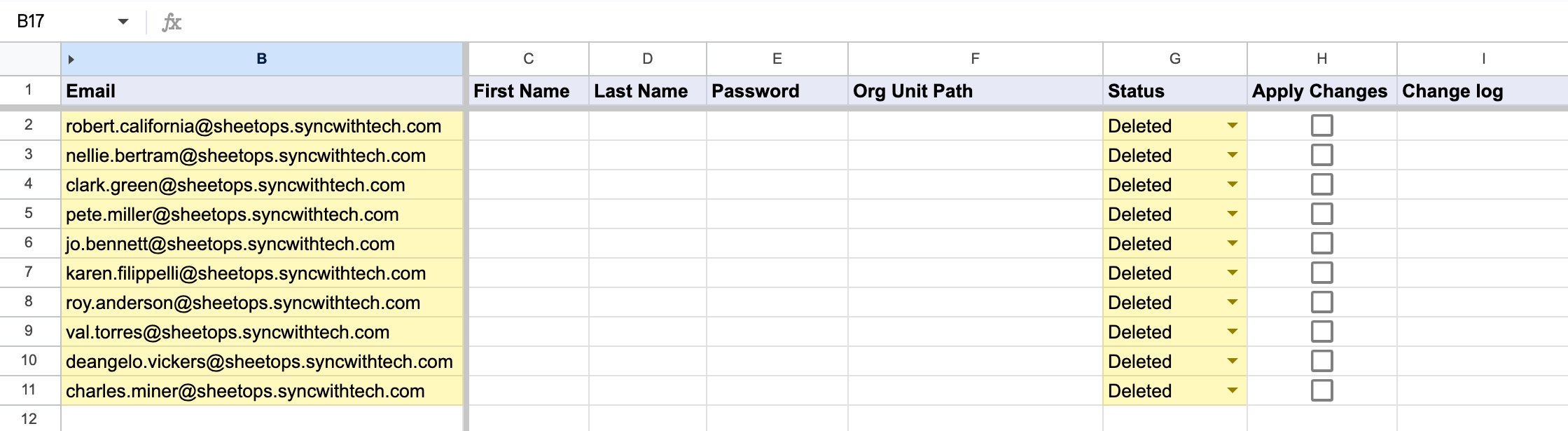
[!TIP] When you enter data or select dropdown choices, SheetOps automatically applies a yellow background to the edited cells. This visual indicator helps you keep track of pending changes before you push them.
[!CAUTION] Deleting a user permanently deletes all of their Google Workspace data (emails, drive files, calendars, etc.) after 20 days. Ensure you have transferred or backed up their Google Drive files before deleting the account.
3. Select Multiple Checkboxes at Once
Instead of checking every single box one by one, you can check many of them all at once!
- Click on a checkbox cell in the Apply Changes column.
- To select the other cells:
- Click and Drag: Hold your mouse button down and drag your cursor over the other checkboxes.
- Shift + Click: Press and hold the Shift key on your keyboard, then click the last checkbox cell in your list. This highlights all the cells in between!
- Press the Spacebar on your keyboard to instantly check all the selected boxes at the same time.
4. Confirm the Update in the Interactive Dialog
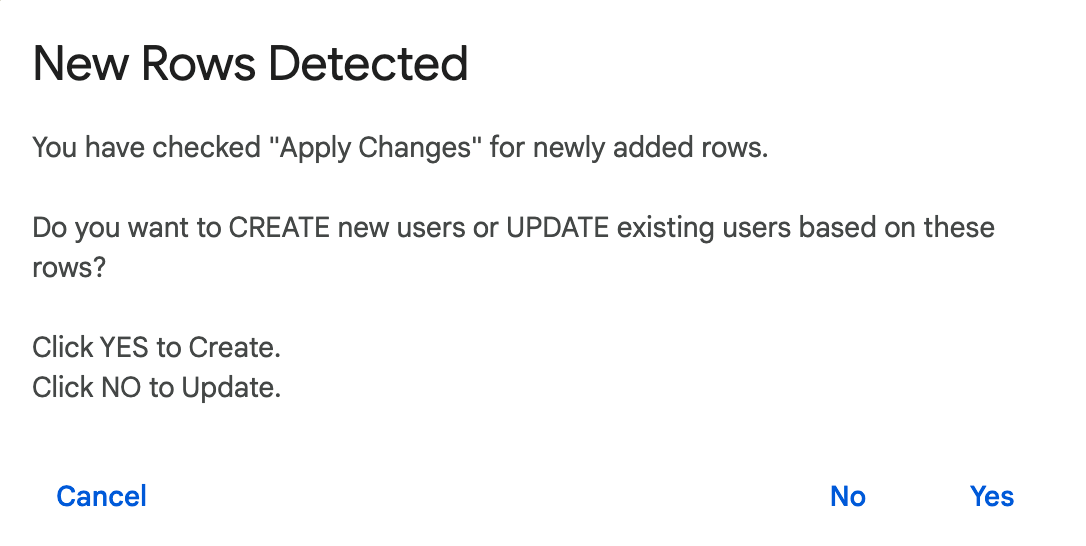
Once you press the Spacebar, an interactive dialog will pop up asking: "Do you want to CREATE new users or UPDATE existing users?" Select No (Update) to tell SheetOps to start updating your existing users' status to deleted.
5. Review the API Result and Change Logs
As SheetOps goes to work updating the users in the background:
- The yellow highlights will disappear as each row is processed.
- The Change log column (the last column on the right) will show the status:
- ✓ Deleted (highlighted in light green) with a green checkmark when the deletion succeeds.
- ✗ error_message (highlighted in light red) if something goes wrong, explaining the error.
How to Undelete or Restore Deleted Users
Google Workspace keeps deleted user accounts in a restorable state for 20 days after deletion. You can search for and restore these accounts in bulk using SheetOps.
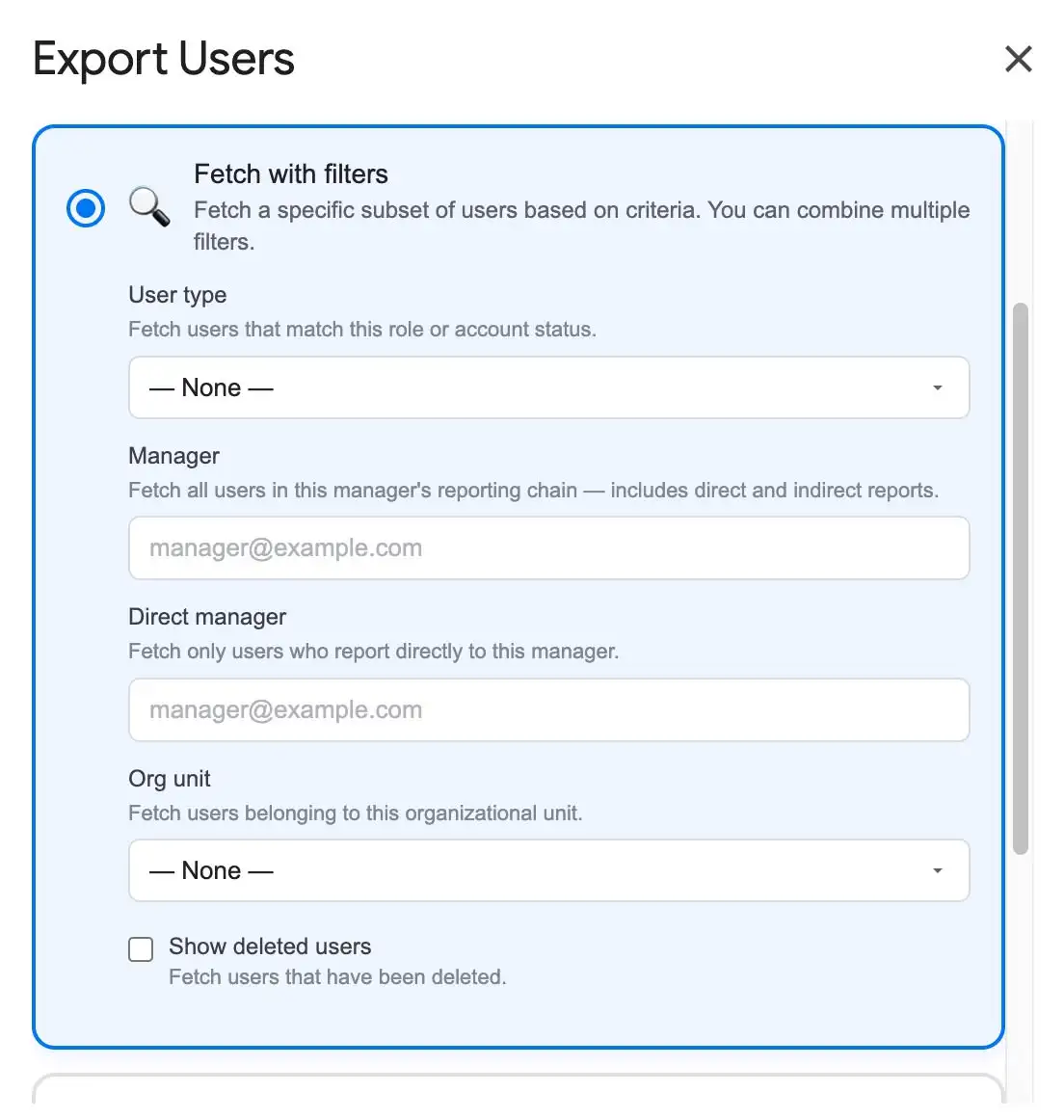
- Go to Extensions → SheetOps → Users and select Fetch with Filters.
- Tick the checkbox for Show deleted users and click Fetch. This loads recently deleted users into the spreadsheet and sets their Status column to
Deleted.
- In the status dropdown for the deleted user, change their status from
Deletedback toActive(orSuspended/Archived). You can also use the drag-to-fill handle to restore multiple users in bulk. - Check the Apply Changes checkbox for those rows (using the multi-select Spacebar trick for bulk operations).
- Click apply, and in the interactive confirmation dialog, select No (Update).
- Once complete, the Change log will display ✓ Updated once successfully restored.
Troubleshooting & Best Practices
- 20-Day Limit: If a user has been deleted for more than 20 days, their account is permanently deleted and cannot be restored via the API or SheetOps.
- Licensing: Re-enabling a user requires an available Google Workspace license. If your organization has run out of licenses, the restore operation will fail with an error log in the sheet.
- Data Retention & Transfer: Deleting a user blocks login access and eventually deletes data. If you wish to save on licenses but keep data Vault-searchable, use Archive instead of Delete. For more details on data transfer, see Google's Data Transfer tool.
- Email Aliases & Forwarding: If you want to prevent incoming mail bounce messages, delete the email aliases or set up routing rules before deleting.
Frequently Asked Questions (FAQ)
Can I transfer Google Drive files automatically during bulk deletion?
No. Google Directory API does not support automatic data transfer parameters during bulk user deletion. You must transfer Drive ownership or set up a backup prior to deleting the user, either manually or via Google's Data Transfer tool in the Admin Console.
What happens if I restore a user but do not have enough Workspace licenses?
The restore operation will fail. Google Workspace requires an active license to assign to the restored account. If your domain's licensing pool is empty, the API will throw an error and SheetOps will log the failure in your spreadsheet's 'Change log' column.
Can I see who deleted a user in SheetOps?
SheetOps does not store deletion history. However, all deletions performed via the Admin Directory API are logged in your Google Workspace Admin Audit Log in the Google Admin Console.
Last updated: June 18, 2026

Ready to manage Workspace at spreadsheet speed?
Install SheetOps from the Google Workspace Marketplace today and start performing bulk directory updates, onboarding, and audits directly inside Google Sheets.